Are You Prepared for an OSHA Inspection?
OSHA Inspections and Fines: The Growing Impact on Small Businesses
OSHA Inspections Target Small Businesses
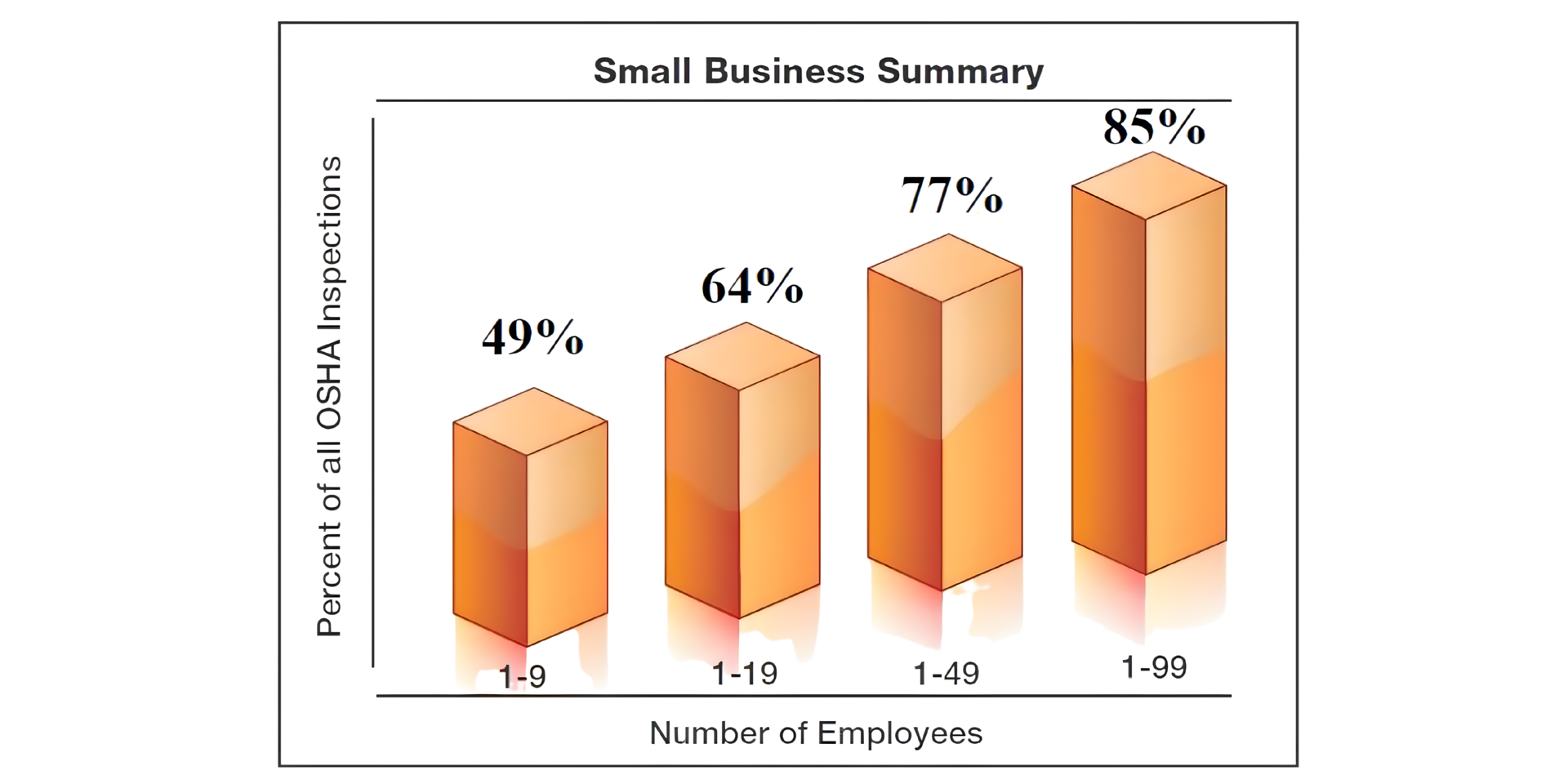
Smaller companies are inspected and fined more frequently than larger companies a statistical fact shown by OSHA data. According to the chart, 49% of all OSHA inspections involve businesses with 1–9 employees, 64% for 1–19, 77% for 1–49, and 85% for 1–99 employees. This means that the smaller your company, the more likely you are to be inspected.
In 2024, OSHA fines totaled $370.3 million, representing an increase of $79.2 million (27%) compared to 2022. Small businesses must understand that compliance is not optional inspections are increasing yearly.
OSHA Inspection and Fine Distribution by Company Size
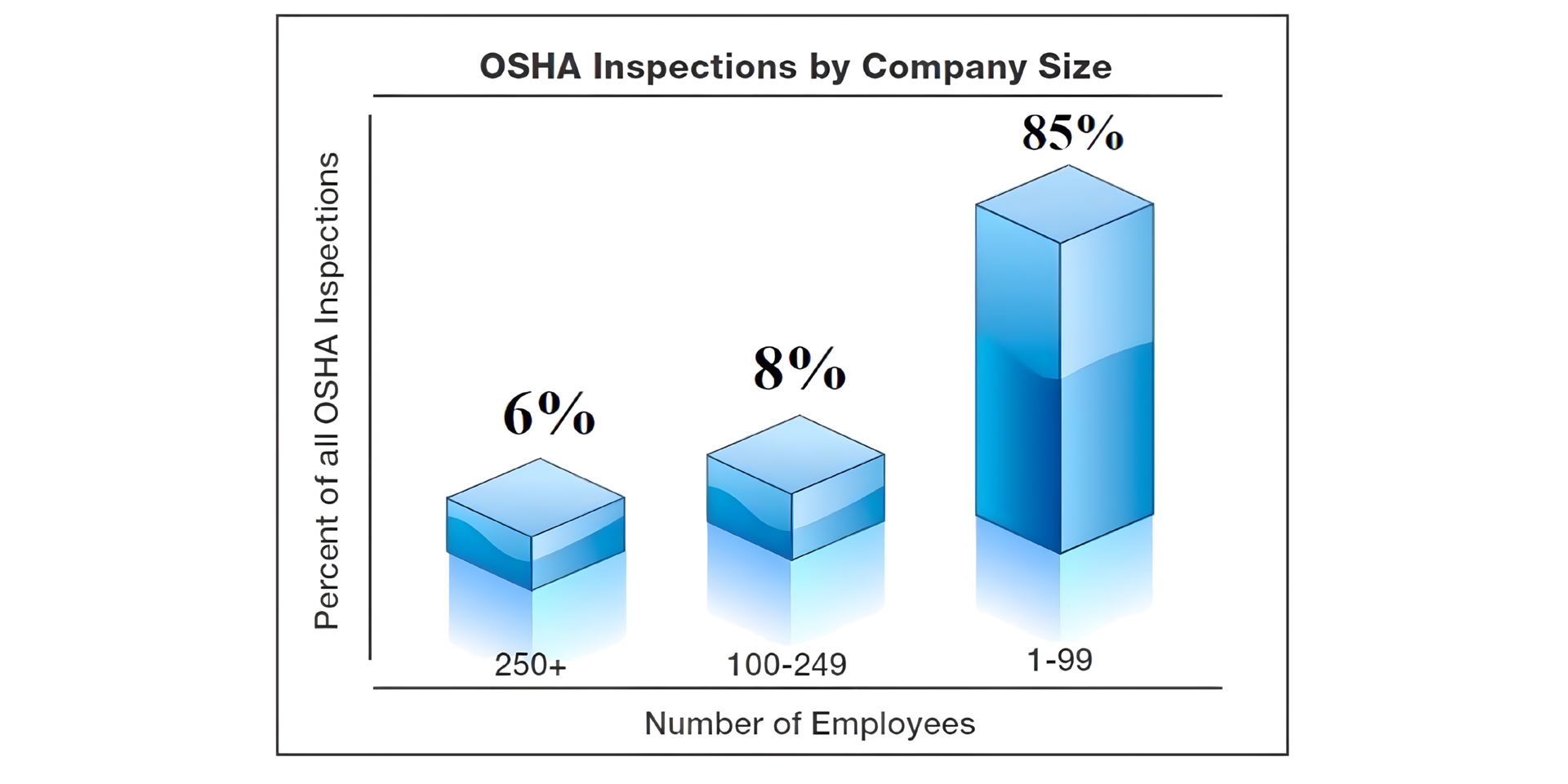
Data shows that 85% of all OSHA inspections involve companies with fewer than 100 employees, while only 8% involve firms with 100–249 employees, and just 6% involve large corporations with 250+ employees.
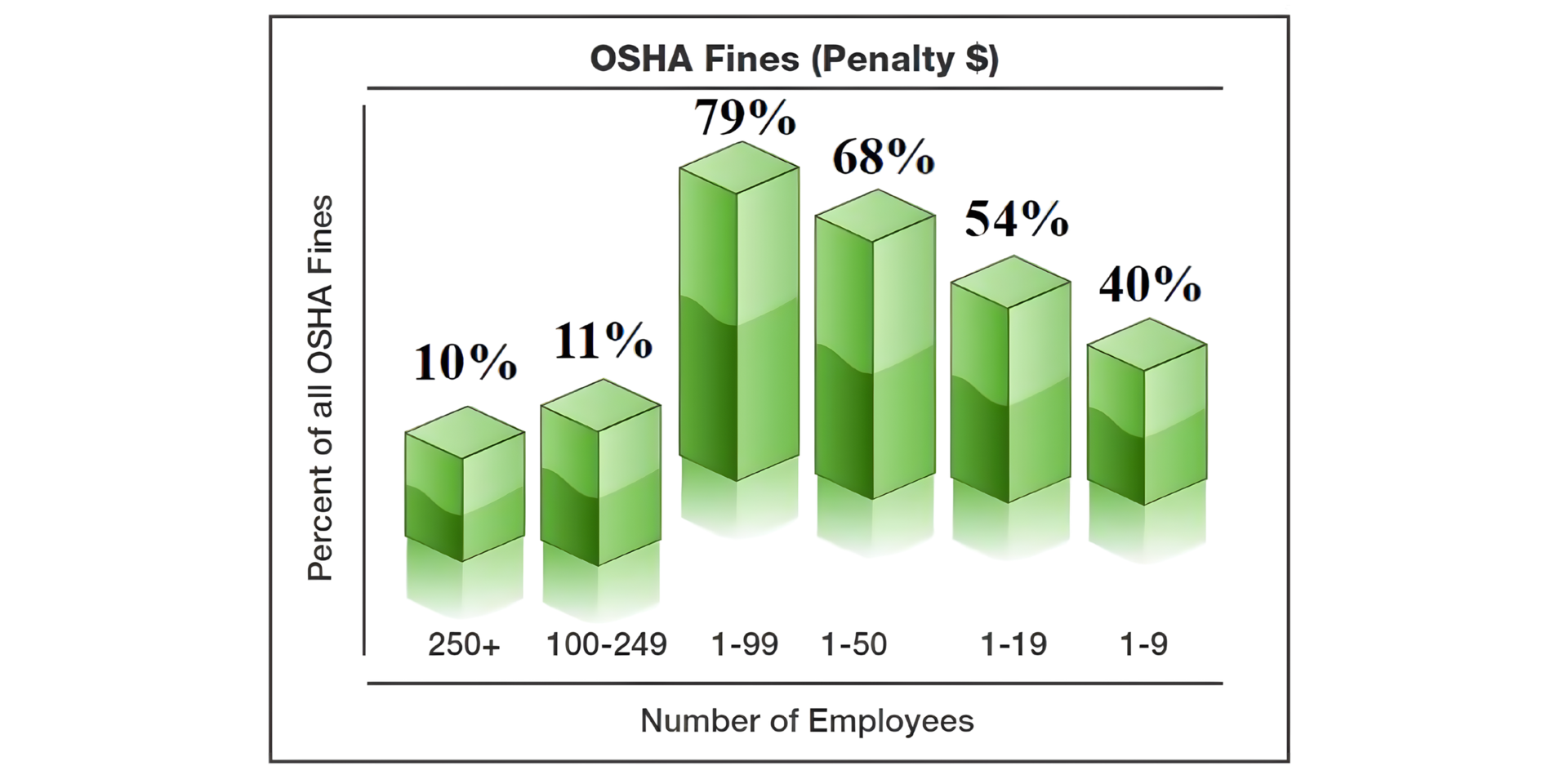
Similarly, when it comes to penalties, smaller companies again take the biggest hit 79% of OSHA fines are issued to employers with 1–99 employees, 68% to those with 1–50 employees, 54% for 1–19, and 40% for 1–9 employees. Large firms with over 250 employees account for only 10% of all fines.
These numbers prove that small businesses face not only more inspections but also more fines.
OSHA Fine Amounts and Penalty Ranges
Employers must be aware of OSHA’s penalty structure. The minimum fine for willful violations is $5,000, and for companies with 50 or more employees, the minimum increases to $25,000.
Each willful violation can carry fines up to $165,514. In 2024 alone, OSHA collected over $370.3 million in fines nationwide.
Smaller employers (those with 50 or fewer employees) can still face steep penalties despite the lower minimum, making proactive compliance vital.
Source: U.S. Dept. of Labor – Occupational Safety & Health Administration (OSHA). Statistical and Inspection Data, February 2025.
Work Safe Solutions, Inc., 3309 N. Oakley Avenue, Chicago, IL 60618 | 773.871.6319 | worksafesolutions.com
Types of OSHA Inspections & Violations
Types of OSHA Inspections
OSHA inspections are unannounced and can happen to any business, at any time. Employers have no control over when or how an inspection occurs. These are the four main types of inspections conducted by OSHA:
- Planned Inspection – Your business is selected for inspection because it falls within a targeted high-risk industry. OSHA uses national and regional scheduling programs to determine which companies to inspect.
- Complaint Inspection – Triggered when an employee files a safety or health complaint. OSHA must respond to all valid complaints, and employee identities are kept confidential.
- Accident Inspection – Conducted after an employee injury, hospitalization, or fatality. The purpose is to determine if OSHA standards were violated and whether corrective actions are necessary.
- Referral Inspection – Initiated when another government agency, individual, or OSHA inspector refers a case to OSHA. Even if your business has already been inspected, a referral may trigger an additional inspection if new hazards are reported.
All OSHA inspections are unannounced, unscheduled, and not optional. There is no advance warning before an inspector arrives, making preparation and compliance essential at all times.
Types of OSHA Violations
After an inspection, OSHA may issue citations depending on the nature and severity of hazards found in the workplace. Violations are classified as follows:
- Willful Violation – The employer knew that a hazardous condition existed but failed to correct it. Penalties range from $5,000 up to $165,514 per violation. For employers with 50 or more employees, the minimum fine is $25,000 per willful violation.
- Serious Violation – A hazard that could likely cause death or serious physical harm. Each serious violation may carry penalties of up to $16,550.
- Repeated Violation – Cited when an employer has been previously cited for a similar condition within the past three years. Each repeated violation may result in fines up to $165,514.
- Failure to Abate Violation – If the employer does not correct a cited hazard by the abatement deadline, additional penalties of $16,550 per day may apply until the issue is resolved.
OSHA FACTS

Did you know?
Smaller companies are inspected & fined with greater frequency than larger companies? It is not only surprising but also a statistical fact.
$381.2 million in OSHA fines were generated last year.**
Increase of $90.1 million from the previous year (2022).
Minimum $5,000 fine for willful violations.
For the employers who operate small firms—those with 50 or fewer employees—in no case will the proposed penalty be less than the statutory minimum, i.e. $5,000. $25,000 minimum for employers with 50 or more employees.
Up to a $161,323 fine for willful violations.
Willful violations can bring a fine of up to $161,323 for each such violation.
SOURCE: U.S. Dept. of Labor. Occupational Safety & Health Administration. Statistical & Inspection Data: Frequently cited OSHA Standards. Federal Jurisdiction. All Industry Groups posted January 2024 on OSHA web page www. osha.gov. **According to 2023 statistics for Federal & State Jurisdiction.

Common types of OSHA inspections include:
• The targeted business has no control over initiating the inspection process.
• Inspections are not scheduled with the business.
• There is no warning to the business.
• Inspections are unannounced.
PLANNED
OSHA has targeted your business for inspection because of your industry. Because your business operates within the targeted industry, you are inspected.
COMPLAINT
When/if an employee files a complaint with OSHA they are required to respond. Complaints are confidential. The complaining employee will not be disclosed.
ACCIDENT
An employee accident or injury has alerted OSHA to your operation. OSHA inspects your operation following the accident or injury.
REFERRAL
OSHA has been referred to your business. The referral can originate from a number of sources but it is not uncommon for one OSHA inspector to refer another OSHA inspector to your operation. This can mean your business is receiving another, completely separate, OSHA inspection after having just received an initial inspection.
* Reprinted from: Employer Rights and Responsibilities Following an OSHA Inspection (OSHA 3000)
WILLFULL
A willful violation is defined as a violation in which the employer knew that a hazardous condition existed but made no reasonable effort to eliminate it and in which the hazardous condition violated a standard, regulation, or the OSH Act. Penalties range from $5,000 to $161,323 per willful violation, with a minimum penalty of $25,000 for a willful serious violation. For employers who operate small firms–– those with 50 or fewer employees––in no case will the proposed penalty be less than the statutory minimum, i.e., $5,000.
SERIOUS
A serious violation exists when the workplace hazard could cause an accident or illness that would most likely result in death or serious physical harm, unless the employer did not know or could not have known of the violation. A penalty of up to $16,131 for each violation may be proposed.
REPEATED
An employer may be cited for a repeated violation if that employer has been cited previously for a substantially similar condition and the citation has become a final order of the Occupational Safety and Health Review Commission. A citation is currently viewed as a repeated violation if it occurs within 3 years either from the date that the earlier citation becomes a final order or from the final abatement date, whichever is later. Repeated violations can bring a fine of up to $161,323 for each such violation.